↑↓ navigate ⏎ go esc close

Drones & Autonomous Weapons RSS

Military drones, autonomous combat, counter-UAS, swarm warfare — the machines are here

Anduril Industries autonomous weapons platform with Roadrunner and Lattice OS
Autonomous Weapons Feb 2026

Anduril Industries: Building the Arsenal of Autonomous Weapons for the U.S. Military

Valued at $28 billion, Anduril is constructing Arsenal-1 — a 5-million-square-foot factory in Ohio that will produce tens of thousands of autonomous weapons annually starting July 2026. Their Lattice OS ties it all together: drones, sensors, and weapons in one AI command layer.

Read source

Anduril Industries, founded in 2017 by Palmer Luckey (Oculus VR creator), has become the most consequential new defense company in a generation. Their approach is software-first: build the AI operating system, then attach weapons to it.

Key platforms:

Lattice OS — an AI-powered operating system that fuses data from every sensor and weapon on the battlefield into a unified command layer. Think of it as the Android of autonomous warfare — one OS controlling everything.
Roadrunner / Roadrunner-M — a 6-foot twin-turbojet autonomous aircraft that’s part drone, part missile. Roadrunner-M is a reusable interceptor for counter-UAS missions at $125K–$500K per unit — far cheaper than traditional missile interceptors.
Altius — tube-launched fixed-wing drones for ISR and strike. Launched from ground vehicles, aircraft, or ships. Multiple variants from small tactical to medium-range.
Fury (YFQ-44A) — Anduril’s Collaborative Combat Aircraft (CCA) for the Air Force. An autonomous fighter jet wingman designed to fly alongside manned aircraft.
Ghost — small VTOL reconnaissance drones for special operations
Anvil — autonomous counter-UAS interceptor that physically rams enemy drones

Arsenal-1: The 5-million-square-foot manufacturing facility in Ohio is designed to produce autonomous systems at scale — tens of thousands of units annually. First production begins July 2026. This is the factory that turns Anduril from a technology demo into a mass producer of autonomous weapons.

Major contracts:

• $1B SOCOM counter-drone IDIQ (10-year)
• $642M Marine Corps counter-UAS
• $86M SOCOM autonomy software integration
• CCA program (classified value)

Anduril is explicitly pro-military. Unlike some Silicon Valley companies that have struggled with defense work (Google’s Project Maven controversy), Anduril was founded specifically to build weapons. Palmer Luckey has been vocal that the company exists to give the U.S. military a technological edge through autonomous systems.

With $6.3B in total capital raised and a $28B valuation, Anduril is the highest-valued private defense company in history.
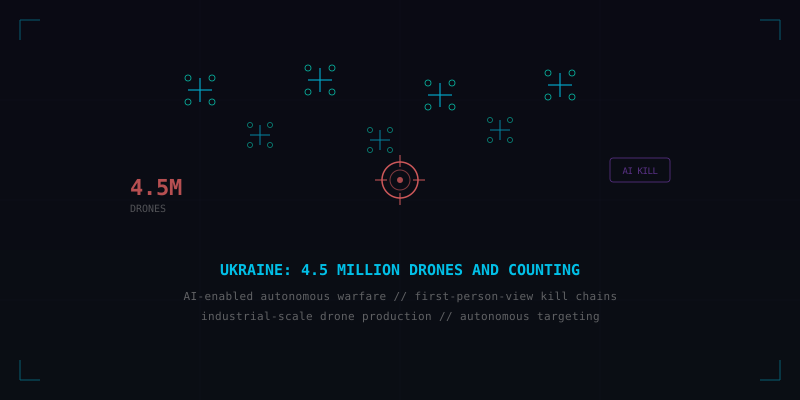
Ukraine autonomous drone warfare with 4.5 million drones produced in 2025
Drone Warfare Feb 2026

Ukraine Produced 4.5 Million Drones in 2025 — Now AI Is Flying Them Autonomously

Ukraine scaled drone production from 2.2M to 4.5M units in one year. Drones now account for 80%+ of all enemy targets destroyed. The front line is increasingly held by machines — up to 90% of supplies to some positions delivered by unmanned ground vehicles.

Read source

Ukraine’s war against Russia has become the world’s first large-scale autonomous warfare laboratory. What started as commercial drones dropping grenades has evolved into an AI-enabled industrial war machine.

The numbers:

4.5 million drones produced in 2025 (up from 2.2M in 2024)
80%+ of all enemy targets now destroyed by drones
819,737 video-confirmed drone hits logged in 2025
90% of supplies to some front-line positions delivered by unmanned ground vehicles

The AI evolution: Early drone warfare required a human pilot for every drone via FPV (first-person view) control. Now AI is taking over multiple roles:

Autonomous navigation — drones fly to target areas without GPS (which Russia jams extensively) using visual SLAM and terrain matching
Target identification — AI models identify vehicles, positions, and equipment from drone camera feeds
Terminal guidance — AI takes over the final approach to target, compensating for jamming and evasive movement
Swarm coordination — multiple drones operating as coordinated groups against defended positions

“We don’t have infantry” — Ukrainian commander, explaining why machines now hold the front line

Western defense companies are using Ukraine as a live-fire R&D lab, trialing modular AI payloads on aerial and ground robots with combat feedback driving rapid iteration cycles that would normally take years. Germany plans to deploy its own AI targeting system (Uranos KI) as early as 2026.

The Ukraine conflict has proven that mass-produced, AI-enabled drones can substitute for infantry in ways that seemed theoretical just two years ago. Every military in the world is watching and adapting.

Shield AI Hivemind autonomous drone swarm coordination system
Autonomy Feb 25, 2026

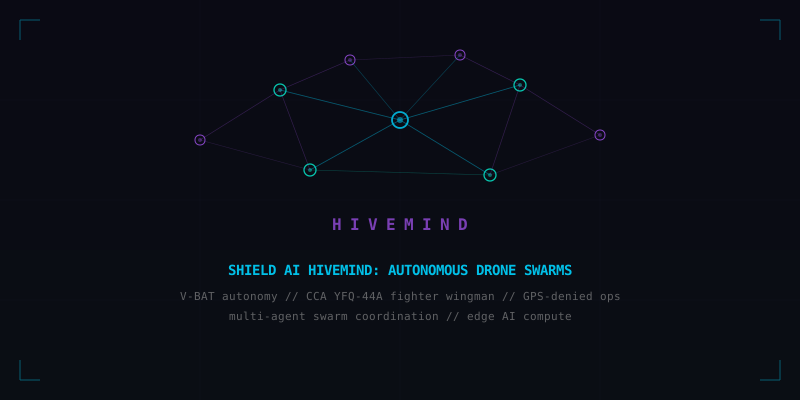
Shield AI’s Hivemind: The AI Pilot That Flew an Autonomous Fighter Jet Over the Mojave

Shield AI’s Hivemind autonomy software just completed its first flight test piloting Anduril’s Fury drone (YFQ-44A) — a Collaborative Combat Aircraft designed to fly alongside manned fighters. Hivemind already identified 200+ Russian targets in Ukraine via V-BAT drones.

Read source

Shield AI is building the autonomy software that makes drones think for themselves. Their Hivemind platform is designed for one scenario above all: GPS-denied, communications-denied environments where drones can’t phone home for instructions.

Key developments in 2025–2026:

CCA flight test — Hivemind piloted Anduril’s Fury (YFQ-44A) autonomous fighter over the Mojave Desert. The Air Force selected Shield AI for Hivemind integration on this CCA platform.
V-BAT in Ukraine — Shield AI’s V-BAT VTOL drones, running Hivemind, identified 200+ Russian targets in 2025. Working with Ukrainian company Iron Belly to integrate Hivemind onto additional strike platforms.
V-BAT Teams — swarm capability allowing one operator to command 4+ V-BAT drones simultaneously with coordinated, autonomous mission execution
Singapore partnership — ST Engineering and Shield AI signed an MOU at Singapore Airshow 2026 to integrate Hivemind onto ST Engineering platforms

How Hivemind works: Hivemind EdgeOS is a middleware framework for autonomous robotics. It handles perception, planning, and decision-making onboard the drone — no cloud connection required. In a GPS-jammed, comms-denied environment, a Hivemind-equipped drone can still navigate, identify targets, coordinate with teammates, and execute its mission.

The swarm angle: Hivemind’s “read-and-react swarming” enables drones to autonomously coordinate without centralized command. Each drone in the swarm makes local decisions based on shared intent and real-time sensor data. This is fundamentally different from scripted formation flying — it’s emergent, adaptive behavior.

Shield AI’s pitch is simple: the future of air combat isn’t better pilots — it’s better software. And Hivemind is the operating system they want running on everything from small tactical drones to autonomous fighter jets.

Skydio X10D autonomous reconnaissance drone for US Army
Recon 2025–2026

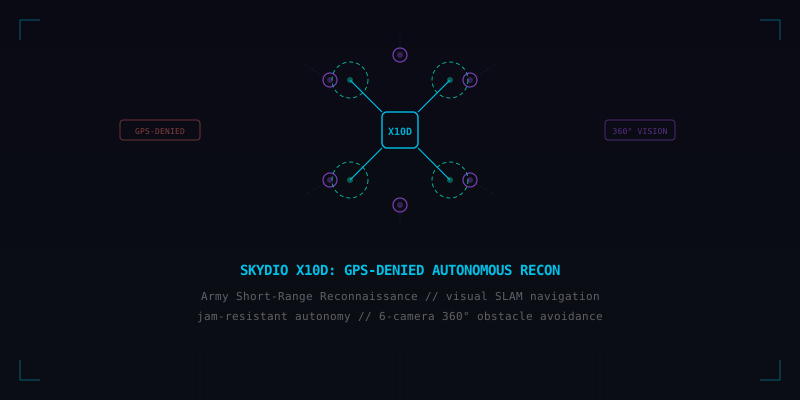
Skydio X10D: The GPS-Denied Autonomous Recon Drone the U.S. Army Just Adopted

Skydio delivered the first X10D systems under the Army’s Short Range Reconnaissance program. Under 4.7 lbs with 360° visual navigation, jam-resistant comms, and full autonomous flight without GPS — all designed and built in the U.S.

Read source

In a world where GPS jamming is the norm on modern battlefields, Skydio built a drone that doesn’t need GPS at all. The X10D uses six custom navigation cameras providing 360° visual coverage to fly fully autonomously using visual SLAM (Simultaneous Localization and Mapping).

Specifications:

Weight: under 4.7 lbs (foldable, rucksack-portable)
Navigation: 6 custom lenses, 360° obstacle avoidance, GPS-denied autonomous flight
Comms: multi-band radio with dynamic frequency selection (jam-resistant)
Sensors: high-resolution EO/IR camera payload
Made in USA: designed, assembled, and supported in Hayward, CA (55,000+ drones shipped)

Military adoption:

• U.S. Army Short Range Reconnaissance Tranche 2 — $7.9M LRIP contract with SAIC
• Royal Norwegian MoD — 101M NOK (~$9.4M) initial tender
• Replacing aging RQ-28A rotary-wing drones across the Army by 2026

Why it matters: The X10D represents the future of squad-level reconnaissance. Every infantry squad gets an autonomous eye in the sky that can navigate complex urban environments, fly through buildings, and operate in the most heavily jammed electromagnetic environments — all without a dedicated drone pilot.

Skydio’s visual autonomy approach is fundamentally different from GPS-dependent competitors. When Russia jams GPS across an entire front (which they do routinely in Ukraine), GPS-dependent drones become expensive paperweights. The X10D keeps flying.

Counter-UAS anti-drone systems for Marine Corps and SOCOM
Counter-UAS 2025–2026

The $642M Anti-Drone Race: How the Military Is Learning to Kill What It’s Building

The Marine Corps awarded Anduril $642M for counter-drone tech. SOCOM has a $1B counter-UAS IDIQ. The Pentagon is spending billions to defend against the same cheap autonomous drones it’s simultaneously trying to mass-produce.

Read source

The military’s drone problem is beautifully circular: they’re spending billions to build autonomous attack drones while simultaneously spending billions to defend against autonomous attack drones. Welcome to the counter-UAS arms race.

Major counter-drone contracts:

$642M Marine Corps — Anduril selected to protect Marine installations from small UAS threats
$1B SOCOM IDIQ — 10-year counter-drone hardware and software contract with Anduril
$250M Pentagon — Anduril drone defense system contract (2024)
$86M SOCOM — Autonomy systems integration for counter-UAS operations

Counter-drone approaches:

Electronic warfare — jamming drone control links and GPS signals. Works against dumb drones, less effective against autonomous ones.
Kinetic interceptors — Anduril’s Roadrunner-M physically intercepts drones at high speed. Reusable if it doesn’t hit anything.
Anvil — Anduril’s autonomous kamikaze interceptor that rams enemy drones
Directed energy — lasers and high-power microwaves. Unlimited “ammo” but limited by power and weather.
AI detection — using radar, acoustic sensors, and computer vision to identify and track small drones in cluttered environments

The cost asymmetry problem: A commercial drone costs $500–$2,000. A Patriot missile to shoot it down costs $3–4 million. Even a Stinger missile is $100K+. The math doesn’t work unless you find cheaper ways to kill cheap drones.

This is why Anduril’s Roadrunner-M ($125K–$500K, reusable) and electronic warfare solutions are getting so much attention. The winner of the counter-UAS race won’t be whoever builds the best interceptor — it’ll be whoever solves the cost-per-kill equation.

Ukraine has already demonstrated the problem at scale: Russia and Ukraine launch thousands of drones daily. Defending against that volume with traditional air defense is economically impossible. The future is autonomous drones killing autonomous drones — and Anduril is building both sides of that equation.

Pentagon Drone Dominance Program $1.1 billion Gauntlet competition
Acquisition Feb 3, 2026

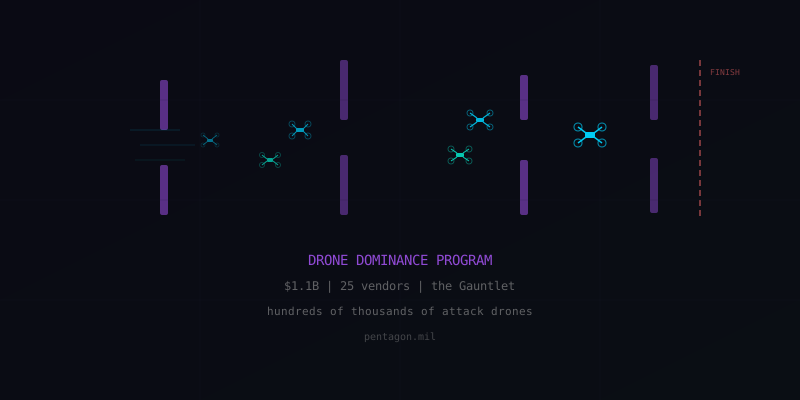
Pentagon’s $1.1B “Drone Dominance” Program Launches the Gauntlet

The Pentagon selected 25 companies to compete in its Drone Dominance Program — a $1.1 billion initiative to field hundreds of thousands of low-cost one-way attack drones by 2027 through a competitive evaluation called “the Gauntlet.”

Read source

The Drone Dominance Program is the Pentagon’s most ambitious drone procurement effort to date. Rather than the traditional years-long acquisition process, the DoD designed a competitive “Gauntlet” where 25 selected vendors bring their hardware and military operators fly and evaluate them directly.

How the Gauntlet works:

Phase I (Feb 18, 2026, Fort Benning) — $150M in prototype delivery orders awarded based on live operator evaluations
Phases II–IV — escalating complexity and funding, with the total program reaching $1.1 billion
• Military operators — not program managers — fly and score every vendor’s system

What they’re buying: Low-cost, one-way attack (OWA) drones — essentially kamikaze UAVs that can be produced at scale and deployed by small infantry units. The goal is hundreds of thousands fielded by 2027.

Why it matters: This is the Pentagon adapting to what Ukraine proved: cheap, mass-produced attack drones win wars. The traditional defense acquisition model (decade-long contracts, cost-plus, single-vendor) can’t produce the volume needed. The Gauntlet model lets the best hardware win through competitive demonstration, not paperwork.

Secretary Hegseth has made drone dominance a top priority, calling it “the most important military technology race of the decade.”

Anduril YFQ-44A CCA swaps between Hivemind and Lattice AI midflight
Autonomy Feb 24, 2026

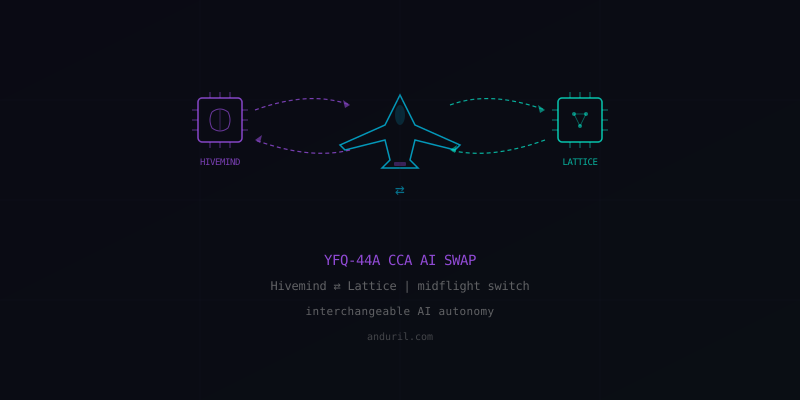
Anduril’s YFQ-44A Swaps Between Two AI Pilots Midflight — A First for Combat Drones

Anduril’s Collaborative Combat Aircraft completed a historic flight test, swapping between Shield AI’s Hivemind and Anduril’s Lattice autonomy systems during a single sortie without landing — the first time a fighter-class drone operated with interchangeable AI brains.

Read source

The YFQ-44A is Anduril’s entry in the Air Force’s Collaborative Combat Aircraft (CCA) program — autonomous fighter-class drones designed to fly alongside manned jets as AI wingmen. This flight test demonstrated something unprecedented: the ability to swap entire autonomy software stacks midflight.

How it works: The swap was enabled by the Air Force’s new Autonomy Government Reference Architecture (A-GRA), a standardized software framework that creates a common interface between the aircraft’s flight systems and its autonomy layer. Think of it as a universal plug — any compliant AI system can slot in.

The two AI systems:

Shield AI Hivemind — edge-based autonomous decision-making, optimized for GPS-denied environments and swarm coordination
Anduril Lattice — full-stack autonomous mission management, sensor fusion, and kill-chain integration

Why interchangeable AI matters:

No vendor lock-in — the Air Force can switch AI providers without buying new aircraft
Mission-specific AI — load Hivemind for swarm operations, Lattice for sensor fusion missions
Competitive pressure — multiple AI vendors competing on the same airframe drives faster innovation
Resilience — if one AI system is compromised or has a vulnerability, swap to the other

This is a foundational step toward the Air Force’s vision of 1,000+ autonomous combat aircraft, each running the best available AI for the mission at hand.

Ukraine Mission Control drone command system in DELTA
Drone Warfare Jan 27, 2026

Ukraine Deploys “Mission Control” — A God-Mode Command System for Drone Warfare

Ukraine launched Mission Control, a unified digital C2 system built inside the DELTA battlefield management platform that centralizes planning, execution, and real-time reporting for all drone operations nationwide — including tracking misses for the first time.

Read source

Ukraine now produces over 5 million drones annually. But until Mission Control, coordination across drone units was fragmented — different units used different reporting methods, and commanders lacked real-time visibility into what was happening across the front.

What Mission Control does:

Real-time operational status — commanders see every drone unit’s current activity, location, and readiness
Hit and miss tracking — for the first time, the system tracks not just confirmed kills but also misses, enabling data-driven analysis of tactics and equipment effectiveness
Gamification — top-performing units earn priority access to new equipment, creating competitive incentive structures
Planning and reporting — standardized mission planning, execution logging, and after-action review all in one platform

Built inside DELTA: DELTA is Ukraine’s homegrown battlefield management ecosystem — essentially their version of a digital common operating picture. Mission Control adds a dedicated drone operations layer on top of it, transforming what was ad hoc coordination into a structured, data-driven command system.

Why it matters: The difference between Ukraine’s drone program in 2024 and 2026 isn’t just more drones — it’s better command and control. Having 5 million drones means nothing if you can’t coordinate them effectively. Mission Control closes that gap, turning quantity into organized capability. Every military planning its own drone force is watching this system closely.

US Marine Corps FPV drone program 10000 drones
FPV Jan 2, 2026

Marine Corps Buying 10,000 FPV Drones at $4K Each, Training Hundreds of Operators

The USMC announced plans to procure 10,000 first-person-view attack drones in 2026 at $4,000 per unit, with six pilot courses and eight certifications — aiming to equip every infantry squad with FPV capability by May 2026.

Read source

The Marine Corps is making the most aggressive U.S. military commitment to FPV drones yet. Ukraine proved that $500–$4,000 first-person-view drones can destroy tanks, armored vehicles, and fortified positions that would otherwise require $100K+ guided munitions.

The training pipeline:

6 pilot courses covering basic operations through advanced attack profiles
8 certifications — basic operator, attack drone operator, payload specialist, instructor, and more
• Covering infantry, reconnaissance, and littoral combat teams across the entire fleet

The math: 10,000 drones at $4,000 each = $40 million total. For comparison, a single Javelin missile costs $175,000. A single Hellfire costs $150,000. FPV drones deliver precision strikes at 2–3% of the cost of traditional guided munitions.

What FPV drones do: A pilot wearing goggles flies the drone in first-person view at speeds up to 100+ mph, guiding it directly into the target. They carry small explosive payloads (typically modified RPG warheads or custom charges) sufficient to destroy vehicles, disable equipment, or breach fortifications.

Why this matters: This is the U.S. military officially adopting the Ukraine model. Every Marine infantry squad getting FPV capability by May 2026 means the Corps expects to fight with these weapons, not just experiment with them. It’s a doctrinal shift — FPV drones are now standard infantry equipment, not a novelty.

European LEAP counter-drone wall along eastern flank
Counter-UAS Feb 20, 2026

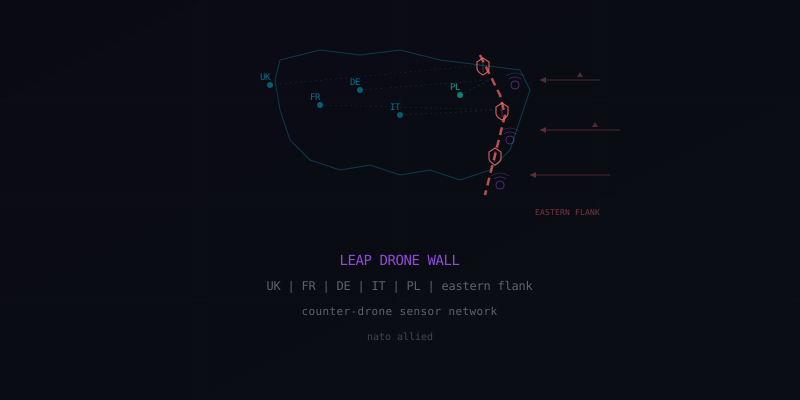
Europe’s E5 Nations Launch LEAP — A Counter-Drone “Wall” Along Russia’s Border

The UK, France, Germany, Italy, and Poland launched LEAP (Low-Cost Effectors & Autonomous Platforms) — a joint initiative to mass-produce cheap drone defenses using Ukrainian battlefield know-how, with an integrated sensor and interceptor network spanning NATO’s eastern flank.

Read source

LEAP represents Europe’s most coordinated response to the drone threat. The five largest European defense spenders are pooling resources to fast-track development of affordable counter-drone systems, with Ukraine’s combat-proven experience informing the designs.

Two parallel initiatives:

LEAP production — joint development and mass production of low-cost effectors (interceptor drones, electronic warfare systems, directed energy weapons) and autonomous platforms
Drone Wall — an integrated network of sensors and interceptors along NATO’s eastern border, designed to detect, track, and neutralize airspace violations from the Baltic to the Black Sea

The Ukrainian factor: Rather than designing from scratch, LEAP explicitly leverages Ukrainian battlefield know-how. Ukraine has been fighting the world’s most intensive drone war for two years and has real-world data on what works, what doesn’t, and what’s needed at scale.

First contracts expected 2027. The nations are committing funding now for R&D and prototyping, with production-scale deployment following.

Why it matters: This is the first time Europe’s major powers have jointly committed to a purpose-built counter-drone defense layer. It acknowledges that traditional air defense (designed for manned aircraft and cruise missiles) is inadequate against swarms of cheap drones. The “wall” concept is new — persistent, layered drone detection and defense across an entire continental frontier.

Pentagon Counter-UAS Marketplace online procurement platform
Counter-UAS Feb 25, 2026

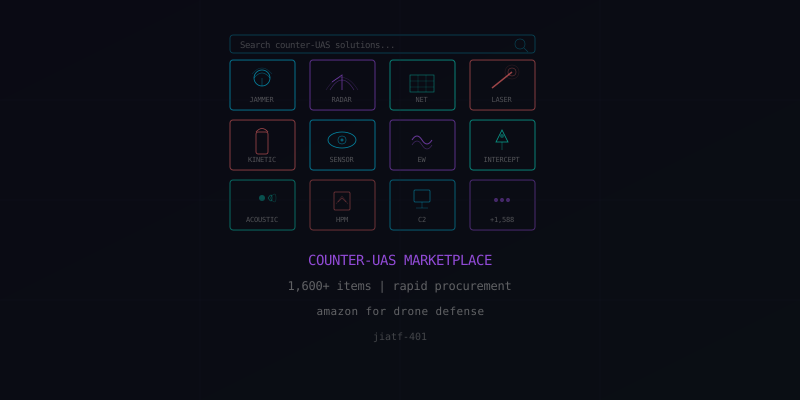
Pentagon Opens “Amazon for Drone Defense” — Counter-UAS Marketplace Goes Live

The Pentagon’s counter-drone task force (JIATF-401) announced its Counter-UAS Marketplace has reached initial operational capability — an online catalog of 1,600+ anti-drone items that military units can browse and order, bypassing traditional procurement.

Read source

JIATF-401 (Joint Interagency Task Force for Counter-UAS) has been the Pentagon’s central coordination body for drone defense since 2023. The Marketplace is their answer to the military’s #1 complaint: “We know what we need, but procurement takes too long.”

How it works:

Online catalog — military personnel browse 1,600+ anti-drone products from vetted vendors
Rapid ordering — bypasses the traditional FAR-based procurement process for approved items
Categories — jammers, radars, nets, directed energy, kinetic interceptors, acoustic sensors, electronic warfare, C2 systems, and more

The market: The global counter-UAV market is projected to expand by over $30 billion between 2025–2035. This marketplace positions the DoD to rapidly evaluate and deploy the best available technology as it emerges.

Why it matters: The drone threat is evolving faster than traditional procurement can respond. By the time a counter-drone system goes through a normal 3–5 year acquisition cycle, the drones it was designed to defeat have already been replaced by newer models. The Marketplace model — continuous vendor onboarding, operator-driven selection, rapid delivery — matches the speed of the threat.

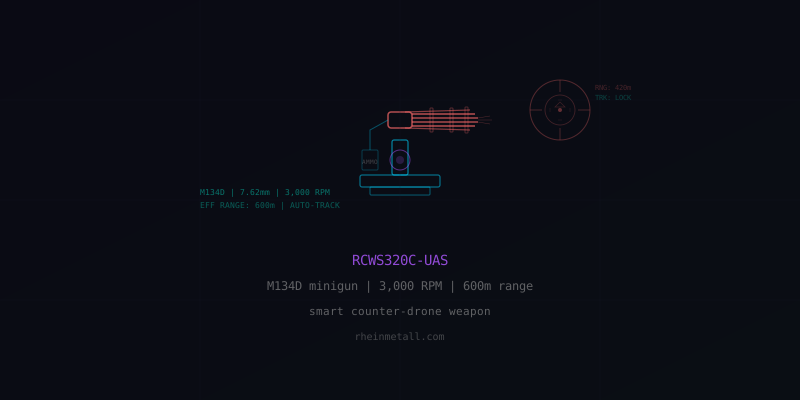
Rheinmetall RCWS320C-UAS minigun counter-drone weapon system
Hardware Feb 24, 2026

Rheinmetall Unveils 3,000 RPM Minigun-Based Smart Counter-Drone Weapon System

German defense giant Rheinmetall debuted the RCWS320C-UAS at Enforce Tac 2026 — a remote-controlled weapon station pairing a Dillon Aero M134D minigun with sensor fusion for automated targeting of drone swarms at up to 600 meters.

Read source

The RCWS320C-UAS is purpose-built for one job: killing small drones at short range with overwhelming volume of fire. It pairs the Dillon Aero M134D — the iconic rotary minigun firing 3,000 rounds per minute — with Rheinmetall’s SEOSS-320 sensor fusion suite.

Specifications:

Weapon: M134D minigun, 3,000 RPM, 7.62mm NATO
Sensors: SEOSS-320 fused radar/electro-optical suite
Coverage: 230° horizontal, 90° elevation
Engagement range: up to 600 meters
Targeting: automated detection, tracking, and engagement

Platform flexibility: The system is modular — it can mount on vehicles (including Germany’s Boxer NNbs short-range air defense vehicle), unmanned platforms, or fixed installations. This makes it adaptable for base defense, convoy protection, or mobile air defense.

Why a minigun? Small drones are hard targets — fast, agile, and small radar cross-sections. Guided missiles are too expensive per shot. Lasers need time on target and struggle in bad weather. A minigun puts 50 rounds per second into a cone of fire, giving you the highest probability of kill against a fast-moving small target at short range. The cost per engagement is measured in dollars of ammunition, not thousands in missiles.

Rheinmetall’s approach is pragmatic: when a $500 drone is diving at your position, you don’t need precision — you need volume.

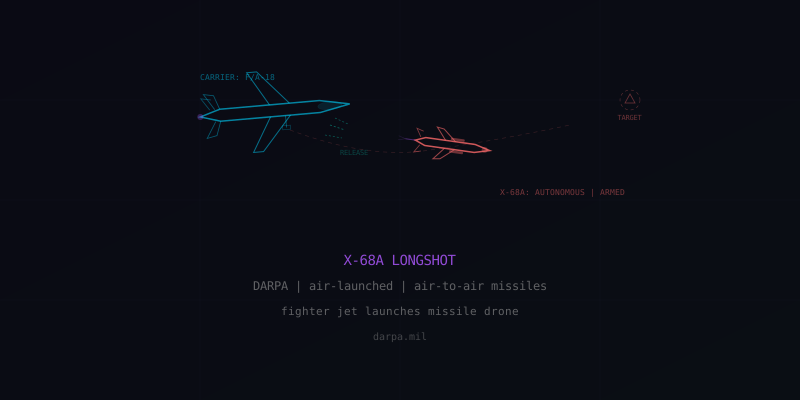
DARPA X-68A LongShot air-launched missile-carrying drone
Hardware Feb 17, 2026

DARPA’s X-68A LongShot: An Air-Launched Drone That Carries Its Own Air-to-Air Missiles

DARPA designated its air-launched, missile-carrying drone as the X-68A after General Atomics completed key milestones. The concept: an F-15 launches a drone that flies ahead and engages enemy aircraft with its own weapons. Flight tests planned for late 2026.

Read source

LongShot is one of DARPA’s most ambitious drone concepts: an unmanned combat aircraft that is air-launched from a fighter jet, flies ahead of the formation, and engages enemy targets with its own onboard air-to-air missiles. It’s a drone that launches missiles — launched from a plane.

The concept:

• An F-15 (or potentially a bomber or cargo plane) carries and launches the X-68A from an underwing pylon
• The X-68A flies ahead of the manned formation using its Williams WJ38-15 turbojet
• It detects enemy aircraft using onboard sensors
• It fires its own air-to-air missiles at the target
• The manned fighter stays at safe distance

Funding and timeline:

• $76.9 million allocated for FY2026
• General Atomics is the prime contractor
• First flight tests targeted for late 2026
• Live-fire missile tests to follow

Why it changes air combat: Today, a fighter pilot must fly within missile range of an enemy to engage. LongShot extends that reach by hundreds of miles — the drone flies into danger while the pilot stays safe. It also multiplies the number of weapons a formation can carry: an F-15 carrying two LongShots, each carrying two missiles, quadruples the flight’s air-to-air loadout.

The “X-68A” designation (the X-plane series includes iconic aircraft like the X-1, X-15, and X-47B) signals that DARPA considers this a serious, test-ready platform — not just a concept study.

Press / to search